
Swiss quote template: how to write a quote that gets accepted
In Switzerland a quote is called an Offerte, and it is the first document a client ever receives from you. A good one answers three questions before anyone has to ask: what do I get, what does it cost, and how long does the price hold. This page walks through the structure of a Swiss quote with every required element, a fully calculated example and the rules on validity. Instead of a Word file, the template here is a structure you fill in directly with Payvetia, in the browser or in the iOS app.
By Payvetia · Updated on
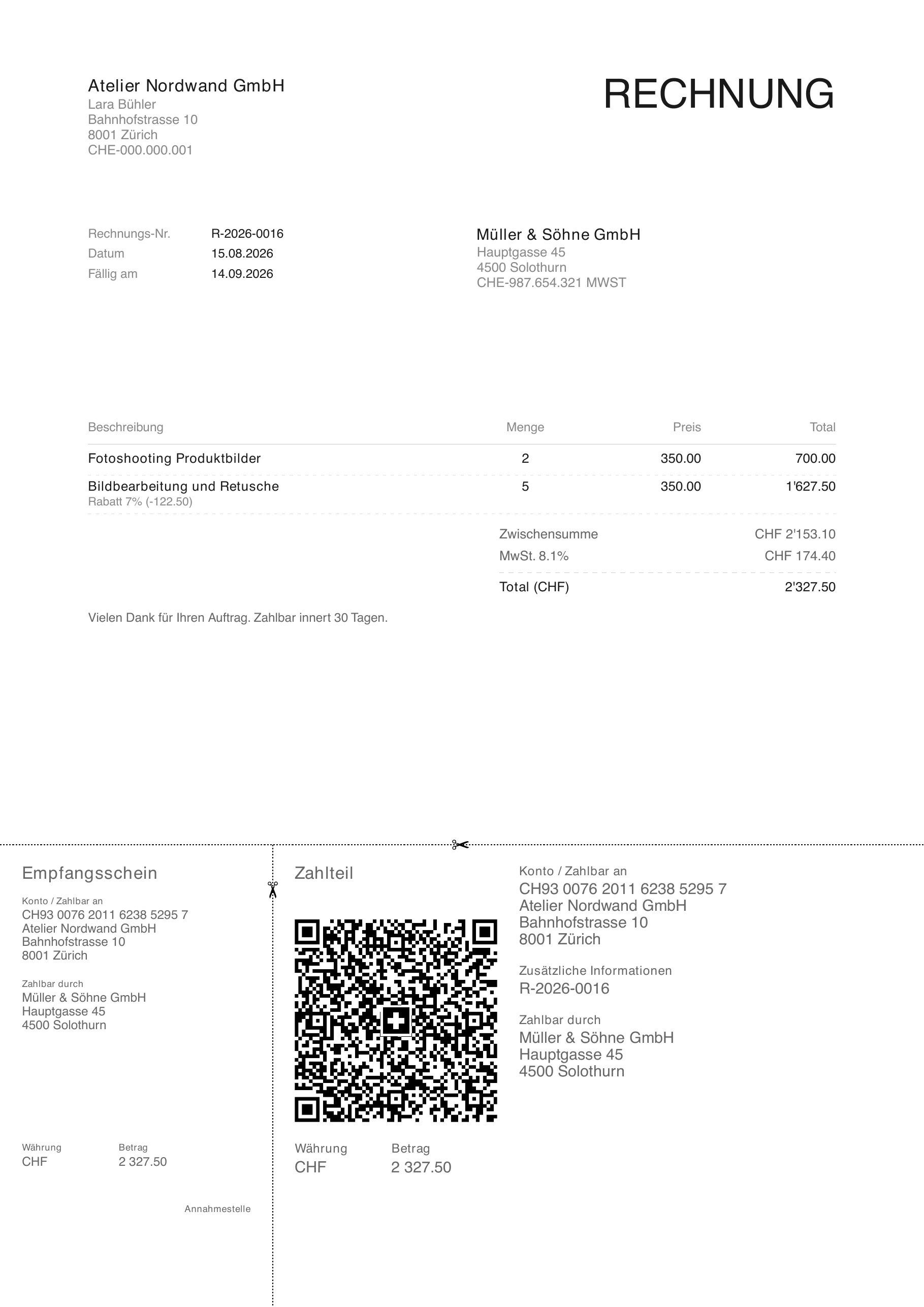
Identical on the quote: company, address, UID and, if VAT-registered, the VAT number. Payvetia takes the header from your profile.
With Payvetia you write the quote in the browser or in the iOS app and turn it into an invoice with QR payment part in one click once it is accepted. Your first 3 documents are free, no credit card.
Try it freeThe most common mistakes in quotes, and how to get them right
Validity
Title and number
Line items
Contents
- The most common mistakes in quotes, and how to get them right
- Quote, cost estimate or invoice: which is which?
- The 10 things every quote must contain
- Validity and binding effect: how firm is a quote?
- Example quote with numbers
- From quote to invoice: one click in Payvetia
- Quotes by trade: what goes on the line items
- Common mistakes in quotes
- Frequent questions about quotes
Quote, cost estimate or invoice: which is which?
The quote (Offerte) is your price offer for a clearly described piece of work. If the client accepts, the deal is agreed on those terms. Germans say Angebot; in Switzerland Offerte is the everyday word, on tradespeople's forms and official paperwork alike.
A cost estimate (Kostenvoranschlag) is looser. It approximates what a job will roughly cost, for example a renovation whose scope only becomes clear once the wall is opened. Deviations within the usual range are expected, and the document should say so. If you name a fixed price instead, you are writing a quote.
The invoice comes last, once the work is done. It demands payment and carries the QR payment part. A quote has no payment slip, because there is nothing to pay yet. The three documents build on each other: quote, order, invoice.
The 10 things every quote must contain
There is no formal law for quotes the way Art. 26 of the VAT Act governs invoices. In practice, clients, fiduciaries and, in a dispute, a court all expect the same details. The order follows the document from top to bottom:
- 1Sender: your name or company with full address, email and phone. If you are VAT-registered, the VAT number goes in the header.
- 2Recipient: the client's name and address, with a contact person for companies. That way the quote reaches the person who decides.
- 3Date: the issue date. The validity period runs from here.
- 4Quote number: unique and sequential, kept separate from invoice numbers. It reappears later as a reference on the order confirmation and the invoice.
- 5Line items: each service on its own line with quantity, unit (hours, m², flat rate, pieces) and unit price. The more concrete the description, the less argument at the end.
- 6VAT breakdown: if VAT-registered, rate and amount per rate (8.1 %, 2.6 % or 3.8 %). Without VAT registration the line is dropped and the total is the final price.
- 7Total: subtotal, VAT and grand total in CHF, clearly separated. Discounts as their own line, not hidden inside the unit price.
- 8Validity: how long the offer stands, as a specific date or a period from issue. 30 days is the norm.
- 9Payment and delivery terms: payment deadline after invoicing, any deposit, delivery or completion date, and what the price does not include.
- 10Signature and acceptance: your signature and a field for the client to accept with place, date and signature. An accepted quote is the order.
Validity and binding effect: how firm is a quote?
A quote is an offer in the sense of the Swiss Code of Obligations. If the other side accepts within the period, the contract is concluded, on exactly the terms written on the page. That is why the line items deserve care: what is not written down has not been agreed.
Without a validity date, it stays open how long you are bound to your price. Set a period and the matter is settled: after it expires you may recalculate, say because material prices rose or your calendar filled up. Most Swiss businesses write 30 days; in seasonal trades or with volatile material costs, 14 days is common.
If you do not want to be bound, say so: "non-binding quote" or "prices subject to change". The document then counts as an invitation to enquire, not an offer. For your specific situation, ask your fiduciary or a legal adviser; this page describes common practice, not legal advice.
Example quote with numbers
This is what the line-item section of a quote looks like, here for a graphic design project from the demo company Atelier Nordwand GmbH to Muster AG. The rows show the pattern that stays the same in every trade: description, quantity, unit, unit price, amount. Below that: subtotal, VAT and total.
| Item | Quantity | Unit price | Amount |
|---|---|---|---|
| Logo design incl. 2 revision rounds | 1 flat rate | CHF 2'400.00 | CHF 2'400.00 |
| Business cards and letterhead design | 4 hrs | CHF 140.00 | CHF 560.00 |
| Print-ready web banners | 4 pcs | CHF 85.00 | CHF 340.00 |
| Subtotal | CHF 3'300.00 | ||
| VAT 8.1 % | CHF 267.30 | ||
| Total | CHF 3'567.30 |
Below the table come the terms: payment within 30 days of invoicing, delivery within four weeks of acceptance, printing costs not included. Finally the acceptance field with place, date and the client's signature. If the business is not VAT-registered, the VAT line disappears and the subtotal is the total.
From quote to invoice: one click in Payvetia
The quote is accepted, the work is done. Now you need the invoice, with the same line items, the same prices and no typos from copying things over. With a Word template that means: duplicate the file, change the title, assign a number by hand, somehow add a payment part.
In Payvetia you mark the quote as accepted and create the invoice from it with a single click. Every line item, quantity and price carries over, the invoice gets its own sequential invoice number from your counter, and the QR payment part with your IBAN or QR-IBAN is generated automatically to the Swiss Payment Standard. The quote stays on file as a document, linked to the invoice.
Quote numbers and invoice numbers run as separate series so both stay gap-free. Clients and line items are saved once and picked from a list next time. The document language is set per quote: German, French, Italian or English. On the Free plan the first 3 documents are free; VAT on the PDF is a Pro feature.
Quotes by trade: what goes on the line items
The structure stays the same; the line items differ. Four examples from trades where quotes are written every day:
- 1Painters: area in m² per room or facade, prep work like masking and filling in hours, materials as a flat rate or per litre, scaffolding as a separate item. State the number of coats.
- 2Cleaning: work per hour or per property, frequency for recurring contracts (weekly, monthly), cleaning products included or separate, end-of-tenancy cleaning with handover guarantee as its own line.
- 3Caretaking: monthly flat rate for stairwell, grounds and minor repairs, winter service as a seasonal item, material costs as incurred. Contract term and notice period go into the conditions.
- 4Graphic design: concept and draft as a flat rate with a defined number of revision rounds, execution by the hour, usage rights and print files as separate items. Exclude or price printing and licence costs.
Common mistakes in quotes
The most expensive mistake is the vague line item. "Painting work living room, CHF 1'800.00" does not say whether ceiling, doors and window frames are included. If it is not written down, it gets argued at the end, and usually you are the one who pays. Write the quantity, the unit and what is excluded.
Mistake number two is the missing validity date. A quote from February resurfaces in September and the client insists on the old price. One line with a date prevents that. The missing VAT note works the same way: if it is unclear whether prices are inclusive or exclusive of VAT, the client assumes the lower total.
Less visible but just as annoying: quote numbers that collide with invoice numbers because both were copied from the same Word file. Or a payment part on the quote that the client mistakes for an invoice and promptly pays before the work has started. Software that treats quote and invoice as separate document types makes both mistakes impossible.
Frequent questions about quotes
Start with sender, recipient, date and quote number. Then describe each service as its own line with quantity, unit and price, calculate subtotal, VAT and total, and add validity, payment and delivery terms and an acceptance field underneath. In Payvetia you fill in a form for this and receive the PDF.